 Skip to content




UL Solutions GMP certified
BioNatal received UL Solutions GMP certification on September 17, 2026, for manufacturing and packaging black seed oil as a dietary supplement. This certification reflects an independent assessment of our manufacturing and quality systems against applicable Good Manufacturing Practice requirements. It supports our commitment to responsible black seed oil production.
This Phytosanitary Certificate is posted as a sample to show BioNatal LLC imports its seeds directly from Ethiopia. This certificate is for your reference only
and is not updated.
BioNatal LLC is a direct importer of the best and richest Nigella Sativa seeds from Ethiopia. This Certificate issued by Ethiopian Agricultural Authority for Customs purposes in the United States and FDA. This Certificate is direct confirmation that BioNatal LLC uses Nigella Sativa seeds for the black seed oil production of Ethiopian origin. Also, this certificate is confirming the 99% of seeds purity through the Sortex system and freshness of the crop.
BioNatal LLC tests its black seed oil through Eurofins to measure thymoquinone (TQ) and volatile oil content, along with other quality parameters. The attached Certificate of Analysis provides an example of some of the testing we conduct and shows the results for the batch tested. Results vary by batch, and this certificate does not represent the potency of every bottle.
Since August 2018, BioNatal has submitted Nigella sativa seeds from different Ethiopian farms to U.S. laboratories for analysis. This research guides our sourcing decisions and helps us select seeds from farms with a demonstrated history of strong TQ and volatile oil results. We continue working with our farming partners in Ethiopia to maintain consistent seed quality.
In 2022 BioNatal owners with the help of United States farmers was able to collect information of the geographical and weather conditions that may help Nigella Sativa flowers to create higher Thymoquinone level in the seeds. Based on this information BioNatal got the samples from the specific area in Ethiopia that is neighbor to BioNatals regular farms. This time we got the highest ever TQ of 4.64% and signed contracts with the new discovered farms.
BioNatal LLC's cold press method is tested once on each machinery used to press oil. This test is done only one time for the new equipment at the beginning.
BioNatal is the only company in the world to prove the cold pressing method through analysis. Most consumers of black seed oil look at the label contents of the oil bottles, but no one has ever seen official proof. Most of the world's black cumin seed oil suppliers are based in the Middle East and Africa, and these regions use old industrial equipment made for soft sunflower seeds and olive pulp, and are not equipped for the Nigella Sativa seeds. As a result, almost all of the black seed oil in the world market gets burned during pressing, and resellers always say that it is impossible to prove that the extraction was cold officially, which is not valid.
It's actually very easy to prove cold press, but most of black seed oil manufacturers are not interested in these tests. BioNatal has the results of oil analyzes produced on our equipment, where the Benzo(a)pyrene component does not exceed 0.95 μg/kg while the global cold-pressed standard does not exceed 2.0 μg/kg.
BioNatal LLC's cold press method is tested once on each machinery used to press oil. This test is done only one time for the new equipment at the beginning.
Moreover, there is also an in-depth analysis of cold-pressed natural oils. This analysis identifies the performance of all components that arise in the oil at high temperatures during production. According to the international cold-pressed standard, the sum of all four parts should not exceed 10.0 μg/kg. The sum of these components in BioNatal black seed oil is 6.04 μg/kg, so the BioNatal cold press method has been proven even by detailed analysis.
BioNatal submitted black seed oil samples made from Ethiopian and Egyptian Nigella sativa seeds for laboratory pH testing. The laboratory reported values of 3.84 for the Ethiopian sample and 5.20 for the Egyptian sample under the test conditions used.
The attached report provides an example of some of the testing we conduct. Results apply to the specific samples tested and should be interpreted alongside the laboratory’s method and sample preparation.
These results alone do not establish product safety, determine thymoquinone (TQ) content, or demonstrate that TQ caused the difference between the reported values.
BioNatal test its Ethiopian black seed oil for laboratory analysis of heavy metals. The attached Certificate of Analysis provides an example of some of the testing we conduct and documents the results for the specific batch tested.
The report lists the metals analyzed, their results, and the laboratory’s reporting limits. Results shown with a “less than” symbol (<) indicate levels below the stated reporting threshold; they do not establish absolute absence. Results apply to the sample tested and may vary between batches.
BioNatal works with farming partners in Ethiopia to maintain consistent seed quality. We share laboratory documentation to help customers make informed decisions about our black seed oil.
Bionatal LLC is licensed by the Texas Department of State Health Services (TDSHS) for our manufacturing facility in Texas. Our facility operates in accordance with the applicable state requirements associated with this license.
We are committed to maintaining appropriate manufacturing and sanitary standards throughout our production processes.
BioNatal LLC has been accredited by the Better Business Bureau since
October 16, 2026. As a BBB Accredited Business, we commit to its Standards
for Trust, including honest advertising, transparent business practices,
honoring our promises, and responding to customer concerns.
We believe customers deserve clear information and dependable support.
Visit our BBB Business Profile to verify our accreditation, view our
current rating, and read customer feedback.
We test for thymoquinone (TQ) by harvest, rather than testing TQ in every production lot. TQ occurs naturally in black seed oil, and its level can vary. Our oil is not standardized to a fixed TQ percentage, so a result from a tested sample is not a guaranteed percentage in every lot or bottle.
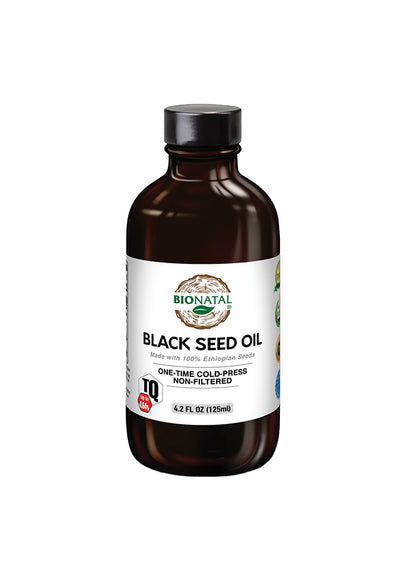
We are replacing the percentage-based TQ badge and "Most Potent" wording with "3rd Party Tested" to describe our testing more accurately.
TQ testing by harvest.
Naturally occurring TQ.
No fixed percentage guarantee.
As we introduce new bottling and filling methods based on our accreditors' recommendations, our bottle sizes are changing:
The oil itself remains the same Ethiopian Black Seed Oil. We are updating fill amounts and how information appears on our labels.
During the transition, you may see different bottle sizes and label versions. Product photos and online listings are being updated in stages, so the bottle you receive may look different from the photos shown online. Thank you for your patience.
Sample documents & internal COAS
Historical sample documents shown on this page are for reference only. They relate to the particular sample, shipment, or date identified and are not a current Certificate of Analysis (COA) for the bottle you receive.
We maintain our laboratory COAs as internal quality records and do not publish them on our website. Our laboratory agreements restrict public sharing of reports and results. This also means we do not publish numerical TQ results from those reports here.
Our UL Solutions GMP certificate is separate from a laboratory COA: it addresses our manufacturing and packaging processes, rather than guaranteeing a TQ percentage in each bottle.
Latest TQ Testing Results & COA
Latest TQ report on file September 24, 2026
Our latest TQ testing is documented internally. We maintain a laboratory report for our most recent tested black seed oil sample. TQ testing is conducted by harvest, rather than on every production lot. Results relate to the sample tested and do not guarantee the same TQ percentage in every lot or bottle.
The Certificate of Analysis (COA) and numerical results are retained as internal quality records. Our laboratory agreements restrict their public disclosure, so they are not available to view or download on this page.
If you have questions about our testing approach or your bottle, our team is here to help.
We are here to help with bottle sizes, label versions, and these updates.