Skip to content






Black Seed Oil Collection
BioNatal Black Seed Oil
Black Seed Oil: Products, Proof & Research
Compare BioNatal liquid oil, 2% TQ softgels, and 5% TQ + DHA—then review label facts, available BioNatal records, and independent research in context.
Evidence first. Research on an ingredient does not automatically establish what a finished product will do. This guide keeps those categories separate.


Start here
What the evidence can—and cannot—tell us
Black seed research spans different oils, extracts, doses, study lengths, populations, and outcomes. The most useful question is not “Is there research?” but “How closely does that research match the product and decision in front of me?”
A broad review assessed many outcomes—but certainty was mostly very low.
A 2023 overview included 20 eligible meta-analyses. Of 110 outcome indicators graded, the evidence for 88 was graded very low, and the authors called for larger, higher-quality trials. The review assessed Nigella sativa literature broadly; it did not evaluate BioNatal products.
Why it matters: study count alone is not proof. Study quality, consistency, formulation, dose, and relevance all matter.
Read the PubMed record (opens in a new tab)Research literacy
Six questions to ask before trusting a study
Use this checklist for any supplement study—not only black seed oil. Strong evidence is specific, transparent, reproducible, and relevant to the actual product and person.
What exactly was studied?
Whole seed, pressed oil, extract, isolated compound, or another preparation?
Who participated?
Consider sample size, age, health status, location, and whether the population resembles you.
What was the dose and duration?
Form, amount, frequency, and study length must match before results can be compared.
What was the comparison?
Placebo, usual care, another ingredient, or no comparison group changes what a result means.
Was the effect meaningful?
Statistical significance and real-world importance are not always the same thing.
What are the limitations?
Look for dropouts, bias, funding, adverse events, null findings, and whether results were replicated.
BioNatal records
Follow the document, not the headline
BioNatal’s quality records are useful when their date, sample, product, method, and limits are read together. A historical or sample-specific record should not be treated as a universal clinical claim.
Analysis & certificates
View available records related to identity, composition, sourcing, contaminants, and facility history.
Open the document libraryProduction process
See BioNatal's sourcing and handling story, including production imagery.
See the processHow BioNatal defines quality
Learn which product attributes matter and why a single percentage never tells the entire quality story.
Explore quality standardsChoose by format
Three practical ways to shop BioNatal
Choose based on format, ingredient list, serving information, and stated composition. TQ percentages describe concentration; they do not guarantee a health outcome.
Liquid oil
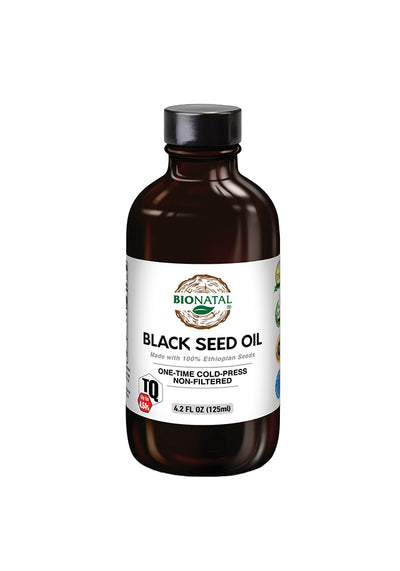
Ethiopian Black Seed Oil
For shoppers who prefer liquid oil and a choice of bottle sizes. Review the current product page for ingredients, directions, and availability.
Softgel format
2% TQ Organic BSO Softgels
A no-measure softgel option made with organic black seed oil. Confirm the current label, serving, ingredients, and warnings on the product page.
Combination formula
5% TQ + DHA Softgels
A black seed oil and DHA formula for shoppers comparing combination products. Check the current label for source, serving, ingredients, and warnings.
Before you use black seed oil
Safety belongs in the main conversation.
Natural does not mean risk-free, and research summaries are not personal medical advice.
- Read the current product label, ingredient list, directions, and warnings before use.
- Speak with a qualified healthcare professional if you are pregnant or nursing, take medication, have a medical condition, or have surgery scheduled.
- Do not use a supplement as a replacement for prescribed care or delay professional evaluation of symptoms.
- Stop use and seek appropriate help if you experience an unexpected reaction.
- Keep products out of reach of children and follow the labeled storage directions.
Quick answers
Research guide FAQ
Does research on Nigella sativa prove that a BioNatal product will produce the same result?
No. Ingredient research may use a different preparation, composition, dose, duration, or population. Product-specific conclusions require evidence that closely matches the finished product and the claim being considered.
What does a TQ percentage tell me?
It describes the stated concentration of thymoquinone in the referenced oil or formula. It does not, by itself, establish purity, overall quality, safety, or a guaranteed outcome.
Are BioNatal certificates the same as clinical research?
No. A certificate or analysis can document a defined test, sample, shipment, product, facility, or date. Clinical research asks different questions about health outcomes in people.
Why are study limitations included?
Limitations help readers judge how much confidence to place in a finding and whether it applies beyond the exact study. Leaving them out can make preliminary evidence look stronger than it is.
Where should I confirm current product details?
Use the linked product or format page and read the current label. Formulas, availability, pricing, serving information, and warnings should always be confirmed at the point of purchase.
Evidence-informed shopping
Choose the format you understand—not the headline that shouts loudest.
Compare current product details, review the available records in context, and bring personal health questions to a qualified professional.
Shop the black seed oil collection